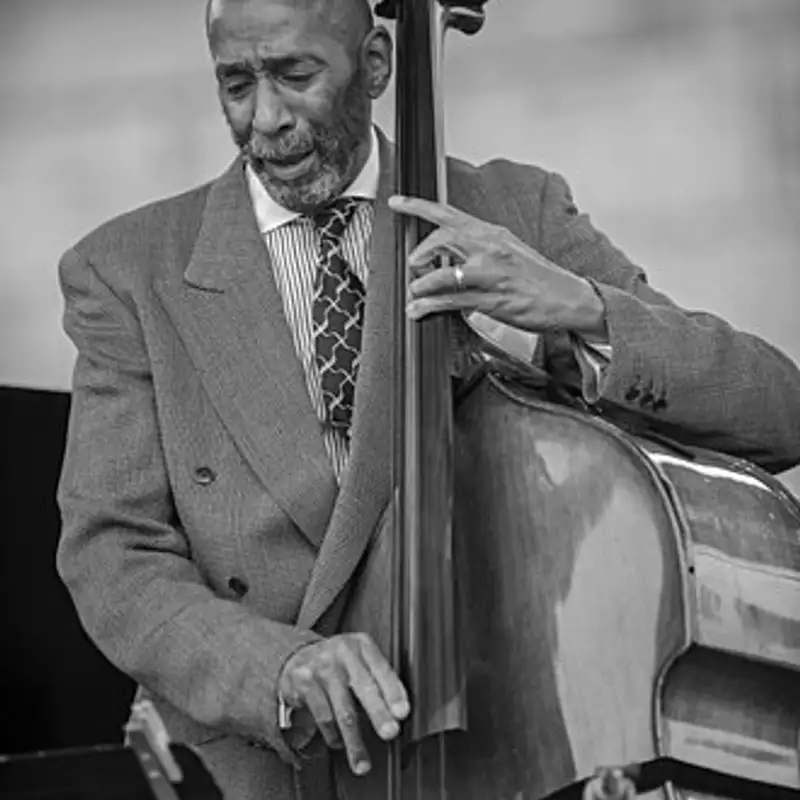
Gene Seymour on Ron Carter
Welcome to The Lives They're Living.
I'm your host, Ben Yakota.
The podcast is about people who
have done amazing things and who,
at this point in their life, are
flying a little bit more under the
radar than they really deserve to be
Ben: My guest today is Gene Seymour.
Gene spent years working for big city
newspapers as a reporter, and movie and
jazz critic, and a TV critic as well.
Right, Gene?
Indeed.
Okay.
And that's where I met him, at
the Philadelphia Daily News.
We were briefly colleagues.
He's the author of a young adult history
called Jazz: The Great American Art.
Currently he lives in Philadelphia.
He contributes mightily on a remarkable
range of subjects from baseball to crime
novels, and many steps in between, to such
places as The Nation, Book Forum, CNN.com,
New Republic, Washington Post, and others.
And I commend his Substack,
That Gene Seymour.
I'll provide a link in the show notes.
, Gene, welcome to The Lives They're Living.
Welcome back, I should say.
It's nice to be back with you, sir.
Yes, sir.
, We were talking about doing another,
session after our first memorable one
for the podcast on Ishmael Reed, who's
in the news interestingly nowadays.
Gene: Yes, hez he.
And we had a world of possibilities,
but you immediately selected Ron Carter.
Why?
You know, when you think about jazz
musicians, particularly, , when you're
talking about them , the habitual
thing, particularly in, in mass
media, is to place in the foreground
those instrumentalists or singers or
whoever, , who have done something
that's conspicuously out front,
who have either acquired the name
because of being innovative or because
they made a big splash somehow, or
they've done something adventurous.
And, and particularly these days, if
you, if you somehow, , associate yourself
with a pop star or a pop phenomenon
the way, say, Kamasi Washington has
with, , Kendrick Lamar and people
like that, you know, you're out front.
But it seems to me that, that
there are so many musicians in, in
the long history of jazz who have
simply sustained and maintained
a reputation by just being there.
Mm-hmm.
And, and not, and not just being
there, but distinguishing themselves
in, in all kinds of situations.
And, often the people that we talk
about are those in the rhythm section,
, pianists, drums, or, or bass players.,
And, you know, it, it's kinda
like, uh, people forget that- these
are the legs and the arms and the
limbs of, of most of the music.
I was reading somebody who said, "Well,
yes, Ron Carter has done a lot of great
things on other people's projects, but,
uh, he has yet to make a masterpiece."
Well, why is that, why
is that always necessary?
Maybe he's the masterpiece.
Yeah.
That's what I'm hearing.
Maybe his body of work is- Right.
Right ⦠his own masterpiece.
And I think that that's why I thought
he'd be the perfect guy to do this.
Yeah.
Not least because he's still
creating that masterpiece.
He's still working.
He, he- He's still performing
Ben: he's still, yeah,
still is a, is a great word.
This guy's amazing.
You know, Ron Carter, , jazz bassist,
although he started out classical cello
I think, and maybe we'll get into that.
That's right.
But he's- That's right ⦠he
just turned, , 89 born in 1937.
Just, just an incredible career that we
will get into, but this factoid popped
out at me, and I hope it's correct.
It was on Wikipedia.
He he is in the Guinness Book
of World Records as the most
recorded jazz bassist in history.
According to Wiki, he's now been
on 2,221 recording sessions.
That sounds right.
And , he's no hack.
He is very, very high quality,
, persistent, and still extremely active.
So anyway, great choice.
And, sadly- I feel that it's, it's
kind of an even better choice with
the, with the news we got this
week of the death of Sonny Rollins.
Right.
You know, the greatest living
saxophonist, probably the
greatest living jazz musician.
, And as I've said,, in, in
various,, forums, I, I've
said that he is the last- Yeah
Gene: of, of the great mid-20th century
innovators, the people who really
kind of pushed the music forward.
And, , I wrote a couple years ago,
um, " When he goes, that's it."
Yeah.
And then everybody else is,
is, are people who came after.
And Rollins is a paradigm of
the very, the type of musician
I was talking about earlier.
The great central figure, a towering,
literally towering hero- Mm-hmm,
mm-hmm ⦠who, who was responsible for
being a kind of signpost for the direction
of the music or a standard-bearer for
what's already been done with music.
, it might be a little bit, you know,
reductive to say that, that people
like Ron Carter move in the shadows
of people like Sonny Rollins.
I don't see it that way.
I've always been more in awe of the people
who are sort of in the background- Hmm.
Yeah ⦠of, of, of, of, of
people like Sonny Rollins.
, The people he had with him, for instance,
for most of his playing time, the
people he had like Bob Cranshaw, who
was a bassist himself, . Bob Cranshaw
was, was his kind of steady rock.
, Al Foster, uh, the great Al Foster, who
I think we lost maybe a year or two ago.
He was, uh, kind of a, a steady figure
who, who came in and out of Sonny
Rollins's career- over the years.
So you have these figures that
have been part of the story,
but they're not necessarily side
dishes themselves necessarily.
Right.
Right.
They are in their diligence
and in their persistence.
Living, breathing role models themselves
And for Ron, I, I presume to call him by
his first name And I, I do Mr- I do M- Mr.
Carter, you know, he is so aware and
so intelligently and elegantly aware
of the tradition, he's got this very,
very active online presence, especially
on Facebook, where I follow him.
So we're talking at a
little bit past 4:00.
2:50 today, like a little over
an hour ago, he posted a Sonny
Rollins tribute with Of course
he recorded his voice and with these
photographs of, I guess it was a trio with
him, Sonny Rollins, and McCoy Tyner, and
just this elegant, eloquent appreciation.
, A couple of days ago, Miles Davis's
birthday, May 26th, Ron Carter posted
, May 26th, 2026 marks 100 years since the
birth of the one and only Miles Davis.
My time playing in Miles' quintet with
Herbie Hancock, Wayne Shorter, Tony
Williams, was like being in a science lab.
Miles was the head chemist, the rest
of us were the chemicals being combined
in new ways and creating new reactions
to each other with every performance.
So he's doing, , similes.
Yeah, well- You know,
that's what you and I do
no, he, no he, he's a, he, he,
he could be a writer himself.
That's the thing about him.
And he has, he has taught.
Yeah.
That's part of what he has done.
He has, he's had an , extensive
teaching credentials.
No question.
He has the capability of, of
being as expressive as that.
And there, there are a lot of musicians
out there who have written, and a few have
even published, work of that of caliber,
And, and, and some of them are
even smart enough to be able to
break it down to the essences where
you and I could understand- Mm.
Mm-hmm ⦠how this stuff works, you know?
Yeah.
Which is kind of a rare quality in some
ways than being able to play it, you know?
Ron Carter has also written an
autobiography, which I'll post
a link to, and, , there's also
a, a documentary about him.
So, you know, he's been, he's been around.
There's a lot of presence.
But, , on this online presence of his,
going down these YouTube rabbit holes,
which, which are great, 'cause once
you start off looking at one thing, it
leads you to- Yep ⦠something else.
And here's the amazing thing.
So he's got this, duet with Herbie
Hancock, Blue Monk, that, that I'll,
that I'll put in in this episode.
, Somebody writes- What,
what a great performance.
And the reply comes from Ron Carter
and says- Yep ⦠"Thank you.
I'm glad you enjoyed it."
Yeah.
So then some guy says, "No.
Yeah, right.
That's really Ron."
It is.
Yeah, it is.
He's out there commenting
on the YouTube comments.
That to me is ⦠A 89-year-old guy,
that, that's- No, he's, he's ve-
that's amazing ⦠he's very engaged
with the world, and he always has been.
The first time I saw him perform live
actually was when I was in college, and
he was part of a, a group of musicians.
At that time, There, there were a lot
of African American musicians who were
bonding together to make sure that their
work was recognized on its own without
having the kind of commercial hype and
push that, that, that, that, that was
deemed necessary for jazz at that time.
This is in the early '70s.
And there was a weekend of these guys
playing on campus, and- Mm ⦠and I
guess it was the final evening, Ron
Carter was there, and he just sat there,
just plopped himself in a stool and just
started stroking the bass, just kind of
letting, letting a melody just come, come
to him and, and just stretched it out.
Ben: And, you know, it,
it was just arresting.
And, and he, and he knew
ex- This was solo, Gene?
Solo Just solo bass?
Only solo.
Improvised?
Which is risky for, which is risky
for a bass player because a lot of
people think, you've got delusions of
grandeur if you think you can hold an
audience by just playing a bass, uh- Mm
Gene: an upright bass.
But he did it, and, and I sat
there thinking, "I neverâ¦"
And by that time I'd seen
people like Mingus and others
in concert, but I had never seen
anyone put together a narrative-
Yeah ⦠quite, quite like he had.
I thought to myself, "This
guy must read novels."
This guy must read books,
really read them- Mm-hmm
and just know how a sentence works
and how a paragraph works and how
to build and how, and how, and
how to draw you back in, you know?
It was a master class not just
in, in playing music, but in, in,
in actually- The simple act of
getting and holding onto attention.
Mm-hmm.
It was, it was very zen,
as some- Yeah, that-
people might say ⦠that's
an amazing experience.
It just, I've never, don't think I've seen
him live, but wa- watching these videos of
him, , couple of words that come to mind.
One, one is, is grace,
and another is elegance.
Yeah.
And he's, he's very elegant guy.
In fact, some of his posts, he's
got the hashtag #planetelegance.
I'm not sure exactly-
Oh ⦠where he gots that.
But the, these fingers of his are so long.
Right.
I feel like they're about twice the,
the length of my fingers as, as you
see him plucking, plucking those notes.
And, not to harp on his age, but this is
a physical accomplishment and physical
feat of playing that instrument.
I think he very briefly played
electric bass, but it's always
otherwise been that upright bass.
He's gotta have good genes, but he's
also gotta really, really work at it.
Yeah.
Yeah.
I remember those fingers struck
me the first time I saw him- Mm
in person.
And, you know, e- every time I see people
like that, and this, this applies to
people like athletes, especially pro
basketball players and, and whatnot.
I wonder if just the act of being
in that profession or being in that
discipline just makes you evolve
to the point where these limbs
become supernally long or whatever.
I've seen a lot of bass players,
and they, and they all have to
some extent that same thing.
But, but I've also seen guitarists with
stubby fingers who can- Mm ⦠pianists.
You know, I mean, I always take it
for granted that people like Horowitz
or, Glenn Gould or, or, or Art Tatum
have these long slabby fingers and
slabby hands, but not all of them do.
They're all flexible and everything
else, and very expressive, but they,
they don't have to be physically big
necessarily to get the effects they do.
But, but Carter seems to have just
evolved into this- Yeah ⦠form
that, that does nothing except
what and who he is, you know?
Ben: On the practice thing, you sent me
a link, where he very graciously tries
to explain where he gets his tone and,
you know, sometimes interviewers like
you and me and the guy in this YouTube
are kind of literal and, not quite on
the level of the artist we're talking to.
But, but Ron tries to explain a- and
he, he talks about his, practicing.
And I think he uses the, uh,
adverb many- Yep ⦠before hours.
I think he says eight manys.
Yeah, yeah, yeah.
Before the hours of practicing.
So that, that is- Yeah ⦠not to be
gainsaid, if that's the expression.
So just a little, , biography.
Born in Michigan, and, and like
you said, he ended up doing a lot
of teaching, and I think he's got,
like, seven honorary doctorates.
But, he got a bachelor's degree
from Eastman School of Music,
master's from Manhattan School
of Music, so he came up that way.
And got that master's in 1961, and it
seems like some of his early sessions
were kind of more in the avant-garde
realm with people like Eric Dolphy,
and that he's mentioned as part of
the third wave m- mixing- Well, Chico-
Gene: jazz and classical.
Well, Chico Hamilton, - Yeah
⦠beginning, beginning in the 1950s, Chico
Hamilton, a drummer, a percussionist,
, , whatever term you wanna use, , he
created a group that allowed the
space for classical or neoclassical
forms and- Yeah ⦠instruments.
One of Chico Hamilton's earlier
groups in the 1950s, which I remember
hearing when I was, like, five or
six years old, had a cello- Mm.
Mm-hmm ⦠uh, instead of a bass.
You know, as, as, first as its own
kind of percussive incident, but also
as one of the frontline instruments.
So particularly in, in those years,
Chico Hamilton created a lot of space
for, , experimenting with tone and
technical blends and things like that.
Ben: I mean, talk about a chemistry set.
That that- Yeah ⦠that
group had that sort of thing.
I, I remember, when Dolphy played with
Chico Hamilton, .. i'm not sure of this,
but I think my, my father used to go to
the Newport Jazz Festival in the summers
every year, and he remembers he and his
friends were kinda sitting there among
all these other beer-drinking revelers,
and remembered seeing some musician
on the saxophone, and he was talking
back to a seagull flying overhead.
It was Dolphy.
He insisted for years it was
Sonny Rollins, and I said, "Nope.
Nope, Dad.
I found out that it was
in fact Eric Dolphy."
And for all I know, , Carter may have
been in that edition- Yeah ⦠of
quartet that night, 'cause it
would've been around the same time.
Yeah.
Late '50s, early '60s.
But that was the framework that people
like Carter were able to sort of establish
their own foundations, and when you have
that impulse to experiment as part of
your foundation, many things are possible.
I mean, right up to, and I know we'll
get, we're gonna get to the, we're
getting ahead of ourselves, right up
to playing with A Tribe Called Quest.
Mm-hmm.
The roots of all that impulse to kind of
expand and reach out start with outfits
like Chico Hamilton or Charles Mingus.
Yeah.
Or Max Roach, or any of the, any of
these modernists from that period.
So, so then, y- in the mid-'60s, he got
into the Miles Davis quintet that we
mentioned earlier, that was really, you
know, I think every y- widely agreed
one of Miles Davis' best outfits.
And- Of course, they call 'em, they
call them the second great quintet.
That's what they call them.
The second great quintet.
Yeah.
And you chose a tune to send me that
I'm gonna play from the album called
Miles Smiles, which is a great title.
, Why did you pick that one?
Gene: A lot of the tunes they played, w-
especially when they were doing acoustic
stuff at, at like '64, '65, up, up until
'67, , there was a shape to what seemed to
be a shapeless approach , to these tunes.
With, with people like Wayne Shorter, who
for many years was considered an oddball
among tenor saxophonists, , there, there
was nonetheless a way that he saw how
you can make tones and themes cohere
without seeming to cohere at first.
And when I picked this particular
piece, I, I thought not just of the
way that, that Carter stands out as
a soloist, you know, either kicking
things off or whatever, but the way his
lines, the lines of what he was doing.
And, and not just the lines, but,
but the purity of the tone in those
lines just keeps everybody kind of
focused and, - not just moving ahead,
'cause ev- every, every musical tune
has its own progression, obviously.
That's why it's called progression.
But the way it just seems to veer off
without losing any connection with
the center of what they're doing.
Mm-hmm.
I mean, it's ⦠That, to me, is, is,
is what makes that group endlessly
fascinating, even more now than, than when
it was when they were actually active.
No, it, it hasn't aged a, a day.
All right, so here is the Miles
Davis Quintet with the tune Orbits.
. Ben: So he, he left, , Miles, , a year
or two after that, I guess before Miles
got into that, I don't know, fusion rock-
Whatever, whatever you wanna call it.
Gene: Yeah ⦠whatever he was doing.
And and since then, , this,
, eclecticism and activity, uhâ¦
So he was a sideman on some, , Herbie
Hancock, , Tony Williams, Wayne
Shorter's recordings, plus he played
with, , Jim Hall, Sam Rivers, Freddie
Hubbard, Duke Pearson, Lee Morgan,
McCoy Tyner, Andrew Hill, Horace Silver.
, You know, I think it would probably make
more sense to say who he didn't play with.
Yeah.
, , So in addition to his skill,
th- these people sought him out.
, He must've been, and still be a, a
people, a person people like to play with.
, The, the term that's often used, and I
think , , it's often misused, particularly
, when somebody's merely prolific,
they call them musician's musician.
Yeah.
But if, but if that term applies
to anybody, it applies to this guy.
Right.
Because he was somebody who was
widely perceived to be a player you
could fit in and plug in anywhere.
He was the all-purpose, , what
do they call a, , they, they
have different kind of wrenches.
Either you're an open-ended metric- Yeah
or you're an adjustable wrench.
And, and you'd much rather have an
adjustable wrench because, you know,
you never know what's gonna happen,
and you may need to really make some
adjustments that can help you along.
And this was somebodyâ¦
This is something that not only
jazz, , musicians and producers
appreciated, but as we'll get into,
pop music people appreciated about him.
Ben: Right.
Well, that was the next thing I
wanted to say, was that, yeah, he,
and some of the YouTube comments on
some of these tracks are not so kind.
But he went outside of jazz and
played with, among many others,
Roberta Flack, Billy Joel, Paul Simon.
I had no idea.
So the- Yep ⦠Paul Simon's first
solo album from 1972, which we
wore out in college, there's this
charming tune on there called Run
That Body Down, and who's the bassist?
Gene: Ron Carter.
You don't run off of that.
And this blew my mind.
He's on The Revolution
Will Not Be Televised.
Yep.
The sort of proto-rap
tune by Gil Scott-Heron.
Mm-hmm.
What?
Well, keep in mind that to guys like
Gil Scott-Heron, Ron Carter is a hero.
He's like an astronaut to-
Right ⦠someone like Gil Scott-Heron.
Right?
If I may use that imprecise,
, analogy for, for the man who
wrote Whitey on the Moon.
But Carter was, was a hero figure to
these guys, and having someone like Ron
Carter accompanying your own poem must
have been an incredible high for him.
You know?
I, I, I can only imagine.
Ben: But, but then, I don't know,
20, 30 years later, he's on, and he
gets name-checked in A Tribe Called
Quest, Verses from the Abstract-
Yep ⦠which also kind of blew my mind.
Yep.
And maybe let's, let's play
that now 'cause that's-
Yeah ⦠that is not to be missed
Ben Yagoda-1: I had a dream
about my man last night.
And my man came by the s-the studio,
and his name is Busta Rhymes in effect.
Shaheed is in effect.
Phife Dawg is in effect.
Check it out and give me my respect.
I'm moving, yes, I'm grooving
'cause my mouth is on the motor.
Bruise the coast in the morning
to avoid the funky odor.
Can't help being funky, I'm
the Funky Abstract brother.
Funky in the sense, but
I play the undercover.
Once had a fetish, fetish for some booty.
Now I'm getting funky in
my rapping, that's my duty.
Brothers tend to jock on
the style in particular.
If you got the ego like some
brothers, then I'll get with ya.
But if I don't pursue, then I just
don't give a . My motto in the
'90s is be happy making ducks.
Girls love the gem 'cause
it causes crazy friction.
When it goes up in, it
fluctuates the diction.
I still understand the oats
'cause that's what I'm at it for.
I'm hooked on the swing, so
just call me the music whore.
Women love the voice,
brothers dig the lyrics.
Quest, The People's Choice,
we driving for the spirit.
If you can't hear it,
then get the wax utensils.
Write my rhymes freehand,
don't give it no fancy stencil.
The rhymes be getting sweet,
we stay away from tart.
A perfectionist at work,
perking up the art.
If you want to battle, I
suggest you check your clock.
Your demise is coming up,
and I want your man to watch.
Be the prime example,
Adepa still the sample.
Insignificance, here I
place you on the mantle.
Born up in Harlem, reside now in Jamaica.
The girl I used to rock,
her moms was a Quaker.
And what does that make her?
The evil money taker.
The crazy move faker, I
use that to break her.
Phife is in the house.
You know you got it going on.
Uncle Mike is in the house.
You say you know you got it going on.
Raw power is in the house.
You got it going on.
Symbol album is in the house.
Wise men is The Brand
Nubians is in the house.
The JBs, they in the house.
And Zaila, they in the house.
I must regroup my thoughts and
kick the next verse for my people.
Please don't be deceived
by the ugly sights of evil.
The world is kinda cold and
the rhythm is my blanket.
Wrap yourself up in it.
If you love it, then you'll flank it.
Don't move to rebuttal.
Wave your hand for action.
Some women in the '90s want
more than satisfaction.
They want keys and keys
and all those illy things.
If you want to, I'll show
you just what the apt bring.
I keep a tight knit with
my brothers Ken and Kenny.
If the question is of rhymes,
then I'll tell you I got plenty.
The thing that men and women
need to do is stick together.
Progressions can't be made
if we're separate forever.
I hook this funky beat with
the loop and the feature.
Here's the funky singing by
Miss Vinnie, a no heater.
So listen because the Quest is
lead through the underground.
My people have been oppressed too
long, no more will we be down.
People tend to riff 'cause
they don't know the mental.
People tend to bug 'cause the
beats are hard but gentle.
Afrika works through the
body of this youngin.
Play like Bobby Byrd on your back
and you're coming to the house of
the jazz, of the funk, of the rhythm.
All the goods are welcome, but if
you're a villain, I'll just wait and
debate, contemplate your arrival.
If flexing is your motive,
then you don't like survival.
The Abstract is speaking.
The heartbeats is reaching.
The Black and poor will leak it 'cause
their butt naked streaking through the
ever murky streets of the urbanized areas.
Blasting out the speakers
is the hip hop hysteria.
Craig is in the house.
You know you gotta go on.
Pete Rock is in the house.
You know you gotta go on.
C.
Clark is in the house.
You know you gotta go on.
O.T.
Mad is in the house.
You know you gotta go on.
Special K is in the house.
Yeah, yeah, yeah, yeah, yeah, yeah, yeah.
And this one goes out to my man.
Thanks a lot, Ron Carter, on the bass.
Yes, my man Ron Carter is on the bass.
And check it out.
Going into the '91 decade up until the
2000 decade, I gotta say, the quest is on.
And goddamn it, yes, the quest is on.
And we out
Ben: I, so as I mentioned, he, he got
some grief from these YouTube commenters,
I guess, who were purists and, you
know, jazz should not be sullied with
the likes of rap and pop and so forth.
, What, what's your sense
of that kind of line?
Actually, I've been working on a piece
that talks about this a little bit.
Gene: Over the years, I've gone back and
forth on fusion, whatever it's called.
I mean, Gary Giddins, my esteemed
colleague, often says that the
problem with fusion is that
nothing gets fused really.
And, , I know what he
means, on many levels.
But, I am far more interested when
the overtures of pop, rock, and
jazz come from the pop, rock end.
When they come over to jazz and try-
Hmm ⦠to sort of merge with them.
You'll agree that, that some of it's
more interesting than, than jazz coming
from their end to merge with, with pop.
I think when that happens, you know, the
purists really get enraged 'cause they
think, "Oh, you're just, you're, you're
just condescending," or you're- Yeah
Or you're selling out just
to- ⦠just to appeal to the,
to the Barbie dolls out there.
I, I don't think it's quite that
simple or quite that reductive.
I'm thinking of people, not
just of A Tribe Called Quest.
For that matter, Kendrick Lamar.
I, I've said for years that if Miles
Davis were still alive, the first person
he'd seek out to play an album with-
Mm-hmm ⦠right now is Kendrick Lamar.
Yeah.
For many, for many reasons, but not least
because that energy that Lamar has matches
Miles' zone, whether as a jazz musician or
as, or as a player, or as a band leader.
Or as a , public figure-
Exactly ⦠as well, I would say.
Yeah.
Yeah.
As, as, as a provocateur.
Yeah.
Yep.
And I think that the reason why, I mean,
Ron ⦠Carter's not going to them.
Okay?
They're coming to him.
Right.
Right.
That, that's the key difference,
and they're coming to him
because they recognize just by
the tone of his instrument- Mm.
Ben: Mm-hmm ⦠that he's something
they want to season, enhance, even-
Yeah ⦠allow what they do to evolve.
Yeah.
Yeah.
No, that, that makes,
that makes great sense.
Well, Ron Carter is, is, present tense-
Yep ⦠is very much out there, and
on his website, which we'll link to,
has a list of his appearances with
his quartet, and he's doing a number
of gigs with Herbie Hancock and with,
I hope I'm, I'm pronouncing this
correctly, Renee Rosnes, the pianist.
Well, . i've called her
Renee over the years.
Maybe, you know, but Renee's fine.
Yeah.
She's played with him a lot, and
they, they have, they have, they
always have a great rapport together.
You know?
So I was gonna actually say- To you
s- do you wanna try to catch their
gig up at the 92nd Street Y in July?
I'm gonna put that- I'm
around ⦠invitation out there.
But short of that, if we can't
make it, it's gonna be streaming.
Okay.
Yeah.
So- Yeah, we'll go ⦠one way or
the other, let's, let's try- I'll
be there one way or another, yeah.
Yeah, let's try to catch that one.
Gene: Anything else that we should
say about the esteemed Ron Carter?
, Well- Everything to me begins and
continues with that tone of his.
And I think what, what makes these
credulous interviewers go a little
slack-jawed when they try to bring
this stuff up is because it's like
when you and I are asked, "Where'd
you get the idea to write about that?"
You know?
Uh-huh.
Mm-hmm.
'Cause that- that's all
they know how to begin.
"Gee, I never thought of that."
"Where, how did you get that idea?"
And I, and I think there's a certain level
of the same kind of, you know, covert
envy when people ask, " How did you g-
what did, what do you hear that I don't?"
Mm-hmm, mm-hmm.
Get the tone out of an
instrument like that.
And I mean, he's very patient when
you ask him about these things.
Yeah, yeah, yeah.
But almost forbearing beyond the pale.
But really, it's not s- that simple.
It's like asking, you know,
why is a yellow rose yellow?
Mm.
It just is.
Mm.
You know?
It's, it's, it's ⦠The tone comes
out of this kind of strange alchemy of
physical, emotional, intellectual- Yeah
you know, compression that sort of
coalesces on, on, on that first note.
On the first note he gets out of
Compared to What, that kind ofâ¦
Which sounds very simple.
It's just a kind of, it's a, it's a
simple kind of, it's a very simple,
it's a very, very basic riff,
but, you know, it gets you there.
And when it gets you there in that way,
and particularly in that song, Compared
to What, I mean, the insinuation, , the
provocations of the song itself,
they are all, set in motion by that
simple riff figure that he gets out.
But it's also the sound of the bass,
where even the wood of the bass is
a conspirator in getting you kind of
focus it's ineffable, but it just is.
It just is.
Yeah.
Yeah, yeah.
, The Compared to What, is that
the, the Roberta Flack one
that you're talking about?
Ben: And, , by the way, when I do see him
at certain clubs, it's always a pleasure.
Gene: He is- there's nothing
wrong with his memory.
He remembers everybody, you know,
but the good things, the bad things.
When you say grace, he is one
of the most gracious people I've
ever encountered, on this beat.
And he, I, I think, I think
he, he's a paragon of that.
Ben: I think that's, that's, that's
one of the many reasons why he's
able to collect all those credits,
because they don't just want him
there- Yeah ⦠because of his chops.
They want him there because he's
just, he's, he's just, he's just
a great person to have around.
Well, and I've gotta say, he's a
good-looking guy and a good dresser.
Gene: He is.
He does wear the hell out of
a- ⦠nice suits ⦠does wear
the hell out of a suit, yes.
Yeah, yeah.
Not that that's always
important, Ben, but, you know.
Thankfully this is not a, , video podcast
so people can't see what we're wearing
Ben: Gene Seymour, thank you
so much for coming on to talk
about the great Ron Carter.
I love talking about the great
Ron Carter at every opportunity.
now here's your moment of Ron Carter.
.
Ben Yagoda-6: I like the
magic of the mystery.
You know, I, I think it's like, uh,
when you, when you define what jazz
is, you make it sound so uncomplicated
so the person will understand the
answer, that the magic, I think, is,
is, is in the complexity of the music.
You know.
And, and, uh, I've been playing
bass since, uh, I was 18.
Yeah, that's, uh, that's,
uh, fifty-fifty-two years.
And, um, I think I decided a long
time ago that it's possible to take
this instrument and make a sound
that I could be held responsible
for each time I play this note.
And to that end, I made a, an exp-- an
example, uh, an experiment, different
sound posts and different strings
and, and, and, uh, different, uh,
um, uh, pressure between the right
and left hand and many, many, many,
many, many, many hours of practice
Thanks for listening and
we'll see you next time