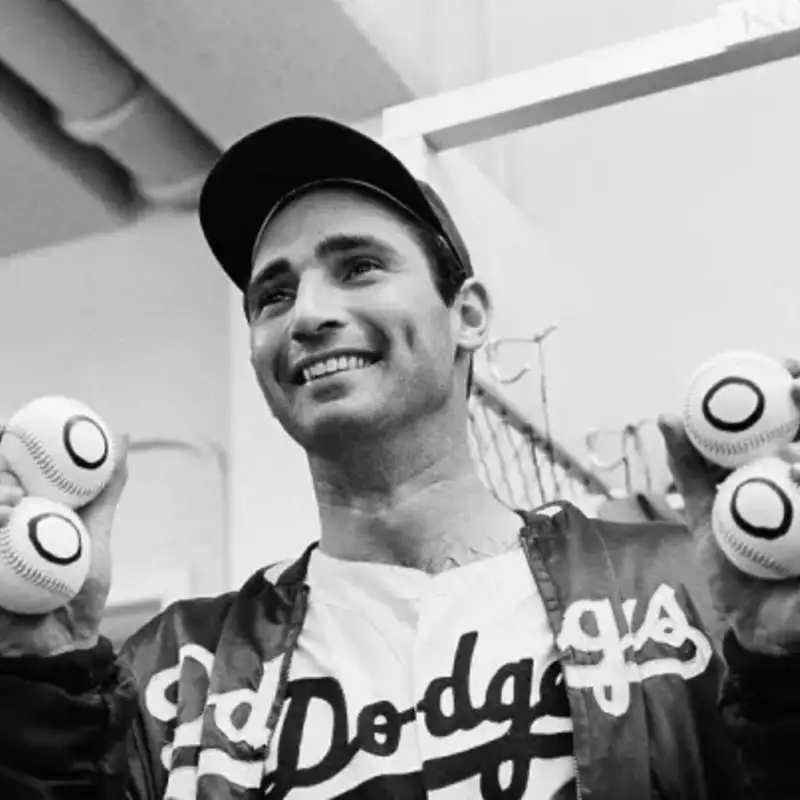
Jane Leavy on Sandy Koufax
Welcome to the Lives they're Living.
I'm your host, Ben Yakota.
The podcast is about people who
have done amazing things and who, at
this point in their life are flying
a little bit more under the radar
than they really deserve to be.
My guest today is Jane Levy, who grew
up on Long Island, where she pitched
briefly and poorly for the Blue Jays of
the Roslyn Long Island Little League.
She worshiped Mickey Mantle from the
second floor ballroom in the Concourse
Plaza Hotel up the street from Yankee
Stadium where her grandmother's synagogue
held services on the high holidays.
She was a staff writer at The Washington
Post from 1979 to 88, covering baseball,
tennis, and the Olympics for the sports
section and writing profiles for the
style section about sports, politics,
pop culture,, along the way, profiling
Danny K, Jane Fonda, Robert McFarland,
and basketball and Mugsy Bogues.
. I guess that's, the profile
was longer than he is tall.
The famously short Mugsy,
I think he's five two.
Okay.
The editor of the style section hung it
from her bulletin board, you know, and
I'm five two, so I could stand next to it.
And, and yes, it was you.
The profile and Mugsy would all
be shorter than a CVS uh, receipt.
Yes.
Then, , Jane moved on to writing books,
beginning with Squeeze Play, which
Entertainment Weekly called the best
Novel Ever Written about baseball.
Followed by the national best sellers,
the big fella Babe Ruth in the world.
He created the Last Boy Mickey Mantle
and the end of America's childhood.
Sandy Koufax left his legacy and
most recently make me commissioner.
I know what's wrong with
baseball and how to fix it.
Jane Levy, welcome to
the lives they're living.
I'm so glad to be here.
, It's great to have you.
You know, I have to start with
1963 and I can say the one game I
personally witnessed Sandy Koufax
pitch First Game of the World Series.
Damn.
I, I was a Yankee fan, as you were, and I,
I, the thing I most remember about it is.
Coming out and the Dodgers were up
first, and I don't think you mentioned
this, and Whitey Ford for the Yankees
struck out two out of the three batters,
and I thought, okay, this game is,
is gonna be, then Koufax came out.
It's there.
I assure you, Ben, it's there.
Oh, okay.
Then I, I missed it.
I, I was.
So enthralled with your
book, which is fantastic.
I just ate it up, so I probably
read it faster than I should have.
But then Koufax came out and
struck out the first three batters,
struck out the side and uh oh,
it was, it's gotta be a long day.
And then in the second inning he did what?
That I don't remember.
I was, oh my God.
He struck out.
Um.
Uh, the next two, including
Mickey Mantle, who muttered to
Dodger catcher Johnny Roseboro.
May I curse?
May I quote, may I quote him to win?
Yeah.
The FCC has no sway
over this, so, oh, okay.
Uh, how in the fuck are you
supposed to hit that shit?
And the Mick, the Mick could
be eloquent, uh, at times.
, Cofaq Seth, the World Series
record for most strikeouts
with 15, I think that that yep.
Lasted for, uh, long time.
No, it's no longer the record,
but it was just a dominant
performance of of many that he had
and you write eloquently about.
And let me just say.
Again, that your book, , I just ate it up.
It was so, well done and, and
interesting and for a baseball fan,
so I, I recommend all readers seek
out that and your other books as well.
So it came out, , over 20 years ago,
but still is as fresh as can be.
But, but let me ask you first, , you
know, you and I are fans, Sandy Koufax's,
legendary, but for those who aren't
fans aren't familiar, can you give
a brief prey or summary of what made
him important as a baseball player?
Well, as most people.
At least our age.
No.
, He's Jewish and the fact is that 19
65, which was his greatest season
undoubtedly, , was only 20 years after
the liberation of the camps in, in Europe.
So to be Jewish in baseball, albeit,
there had been other others, notably
Hank uh, Hank Greenberg, and,
. Al Rosen and you know
others, uh, Litman Pike.
The first, , the rabbi of swat,
I, I was the Rabbi of Legacy.
You mentioned him in the book.
Yeah.
But to acknowledge it forthrightly
to act on it by refusing to pitch
on any of the high holidays, , Yom
Kippur at War Rosh Hashanah.
Without explanation.
I mean, that's the thing.
That gets me the most.
He never capitalized on his Judaism.
He never allowed it to be exploited by
Jewish organizations or anyone else.
His actions spoke, said everything
that he needed to say about it.
, In fact, he is not a
particularly devout man.
What he was, was dutiful and he clearly
recognized his obligation to his
parents, , and to a, a whole community.
, And nor did he think it was a big shmear.
As he has put it, because, after all with
the pitching staff the Dodgers had, and
Don Drysdale being, you know, Sandy won
and won a, you know, he always looked
at it as, so I don't pitch game one.
Big schmear.
Yeah.
Drysdale pitch.
, But it was, it was an incredibly
important statement in part because
in his, , in his physical beauty.
Coordination and the way in which his
body is, , perfectly proportioned.
, And in his gloriously elegant delivery
that belied how much stress it put
on his left arm and his, , and in
particularly his left elbow, , he
defied every st stereotype about Jewish.
Maleness.
He's the anti nerd.
He's the anti nebbish, tall,
dark, handsome, elegant.
, I mean, just perfect.
He had a perfect fastball
and a perfect curve ball.
Today they use the word tunneling, , to
mean that, the pitch comes out of
the pitcher's hand, , the same way.
And so Kofax would throw his
both pitches, overhand 12 to six.
, And batter didn't know whether
it was going up or whether it was
going down until it either went.
Up and passed them or down
and bounced at his feet.
You couldn't tell the difference.
People ask me all the time, , was
he the best left-hander?
Was he the best pitcher?
Other people did it longer and
for more years, more innings, more
strikeouts, more games, more wins.
Warren Spawn notably, , for example,
but you know, in pitcher speak, in
baseball speak, they talk about how
the ball comes out of your hand.
And the first guy I asked was about Sandy.
What made, made coax?
Coax was, , Dave Wallace, the great
pitching coach, coach emeritus to
the, , the Red Sox, the Mets, the
Orioles, the Dodgers, the Braves.
And Dave said, have you shaken his hand?
And I said No.
And he said, you shake his hand
and come back and we'll talk.
Well, I did.
Now I have small hands, , but my hand,
splayed fits in the palm of his hand.
And when I did shake his hand, his
fingers, which are really long, you
put my two middle fingers together and
maybe you've got his middle finger.
, Reached all the way up to my bicep.
So his physionomy allowed him to
control the ball and to do things
with it that other people couldn't.
, He was well aware.
He's not falsely modest guy.
He knew how good he was, , and he
never stopped wanting to be better.
And you had his physionomy.
Along with his smarts.
He may have been the smartest pitcher.
In 2000, major League Baseball organized
a team of the century and they only wanted
there to be one player at each position.
, And so they picked coax
as the pitcher, right?
And he said, I'm not going,
if Warren Spawn is me.
And in fact what happened was, you know,
they said, well, we better have two.
, He knew what Warren's accomplishments
were, you know, just think about that
16 inning game at Candlestick Park
in 62 against, , uh, Juan Marielle.
, zero zero until the bottom of the 16th
when Willie Mays hits a one run home run
off, off of, uh, it did not happen today.
He was 42 years old, you know, and pitch.
So Cindy says, I'm not going pitch,
I was reminded in the book for 21
years as a major league starter.
Exactly.
So what you had that day and
I was there,, Warren was near
the end of his life and frail.
And you know, it, it turns out,
as I've been reminded recently.
It's hard to climb up, , dugout steps.
They're wide.
It's a big rise.
And, , he had a hard time
doing it, so they call Sandy's
name and he refuses to go out.
He waits until they call Warren,
too, and he gives him his arm.
He escorts him up the stairs,
steadies him, walks him up the
ramp to the podium and again.
His actions spoke louder than anything
he could have, , added to that.
, Reading the book, I, I was reminded
of, you know, we're roughly the
same age, so I was around when he
was dominant and had those, was
it four or five years that were.
Best four or five year span of any
pitcher, I think, in baseball history
and kind of made it his name and the
hall of fame and the basis of that.
So it was, it was interesting to
be reminded of and learn about his,
physionomy and, and the physics of,
of the fastball that against the
raw laws of physics rose and the
curve that dropped and all that.
But what I really didn't
know was, was about his.
His character and
personality, his intelligence.
In my Kindle, I, I, I highlighted a line
from the book where you talked about , all
the people you interviewed and, and.
I would say probably a
hundred or so or more.
More, more.
. , Just amazingly well reported book,
but you said there was one word
that was used most often about coax.
Do you remember what that was?
Okay, well, the, and help, help me.
I will.
The spa anecdote bespeak
it and the word was gentle,
which, you know, a world class.
Highly competitive athlete, as you
described, that's not something you
think of, but in his actions as you
described them, it comes through.
He was both gentle in that
way and also fearsome.
One of the things that.
Was particularly rough for him was
the supposition based on ancient
stereotype that Jews aren't tough
now, unlike Don Drysdale, he didn't
throw at people, he did throw inside,
and he always said that the key to
pitching is instilling fear, but.
He got tired of that real
fast, particularly in 65.
And one day in, , St.
Louis, Lou Brock, , got on, I think it
was a bunt and stole second and then
third, and all the players in the dodger
dug out said, oh boy, you know, and
the next time up, I think it was the
next time up, he buried a fastball in.
, The ribs of Lou Brock, ge, Jeff
Tobo, who was the Dodger catcher
that day said it had twisted around.
It spun around in the meat.
And you know, this being the early
sixties or the mid sixties, he trotted
on down to first base and he didn't rub.
, But he was out the next five days,
you know, do not show Sandy Koufax up.
And the same was true late in that
year with a famous incident, set
against in heat of the pennant race,
heat of watts in the background, the
riots, , in, in that part of, of Los
Angeles and all over the country, where
mayor Marchelle took a bat and
tried to hit Roseboro over the head.
In fact, it's Juan Marchelle,
the Giants pitcher, and John
Roseboro was the Dodgers catcher.
Right.
And I remember that incident at the time,
how notorious and scandalous it was.
And he, he did hit Rosie.
And,, there's these pictures that
appeared on the front page of every
newspaper with Sandy rushing in from the
mound with his gigantic hands, right?
Like right in the frame of the
picture , trying to stop it.
And, , in a dugout later, you know,
, Rosie said, uh, well, what you wanna do?
Right?
And Sandy said, who do you want me to get?
Right.
And Rosie says, I'll take care of it.
And so he, he deliberately threw a
ball right past, , Marielle's ear.
But Sandy felt he had
been hung out to dry.
It made him look once again, like
the guy who wouldn't come to the
aid of a teammate and nobody.
Was a better teammate than Sandy Koufax.
Yeah.
Nobody.
And the gentle part of him,
this is not in the book,
I love this story.
When I finished and just as when
it was about to be published, , my
daughter was bat mitzvah.
It was, in the same month as nine 11.
And like most indulgent parents, I
said, oh, invite anybody you want.
And I get the stack of, invitations,
lilac, and there's one for Sandy Koufax.
I go Oy, because I know him
well enough by that point.
To know that, , being the center of
attention, , at somebody else's big
day, , among a group of Jews of a certain
age is not his idea of a good time.
So I called him and I said,
you know, don't come, just
send her an autograph ball.
It's fine.
And he said, oh no,
I'll be there for Emma.
Because after all, I'm the guy
who took her mother away from
her for the last two years.
That's great.
\ You have in the book, , I
wrote down this quote.
I I sort of get the sense that he got
some of this from his parents, especially
his stepfather, who, from the letters
from him that you quote is, is, is
this kind of courtly old school man.
And, and correct me if I get the details
wrong, but he had been talking to another
team, I think it might have been the
Pirates as a teenager, signed with the
Dodgers and, and he wrote this letter.
With the line.
Thank you for being so honest and frank
with me In this cold business where
these few honest men are at a premium,
it's like a teenager writing that.
Well, Irving Koufax was, a
lawyer practiced a small,
individual practice in Brooklyn.
He wasn't a guy commuting to,
Sullivan and Cromwell in Manhattan.
, Not that a, a nice
Jewish guy would've been.
Hired at one of those
white shoe firms back then.
, And, he came into Sandy's
life when he was 10 years old.
His biological father was a man
named Jack Braun and who had
left the family and Sandy and his
mother, , when Sandy was three.
And in the interim, the
man in his life was his
grandfather, , max, an electrician.
And something of a socialist who took
Sandy to a Jewish Yiddish theater
and and talked to him about politics
and this and that and the next thing.
And he was a great influence
on San Sandy's sense of
being Jewish without being.
Overtly practicing.
Mm-hmm.
As, as Fred Wilpon, his friend from
the neighborhood, Bensonhurst said to
me, you know, no, he's not particularly
practicing, but he is a very Jewish being.
Yeah.
As you well know, as you well know,
usually there's one interview that
crystallizes where you have to go
in a book, and that was the one.
Yeah.
It really helped me understand him
well, and part of that, I, I read as a
sense of justice of right and wrong, and
that even relates to the famous holdout
that he and his buddy Don Drysdale did
when that kind of thing wasn't done.
They both said during contract
negotiations, we're gonna walk out
unless you pay us what we're due
and that arguably was the start of
what would later become, , the end of
the, , reserve clause and free agency
and freedom for baseball players.
Yeah.
I was 65 the year that Marvin Miller
was hired to be the executive director
of the Baseball Players Association.
And what, what's significant about it?
. So this is spring 1966.
Sandy already knew , that because
of , the horribly traumatic
arthritis in his left elbow, that
this was gonna be his last year.
Mm-hmm.
You know, he had asked Bob Curl and the
Dodgers a team physician to tell him when
he was in danger of, , hurting himself so
badly that he would no longer be able to
brush his own teeth or comb his own hair
or button his own shirt and curl and went.
Told him that he had reached
that point in spring 1966.
So for San to hold out and, and perhaps
not go back and not get a contract.
You know, again, there's
the phrase, big smear.
Right?
, But Don had a family, young kids, and.
Had to go back.
, So they settled for probably
less than they deserved it.
God knows what they would've gotten and
today's crazy baseball economic market.
But Sandy said it was a union.
It was a small union.
Yeah, yeah, yeah.
At end of two.
And when I did the research, I found
that, that not only did it feel
important, it turned out that it set legal
precedents that were important, that led.
To, , the revolution that would
be, the free agency and the
liberation of, , indentured
servant shortstops 10 years later.
So I you can see the influence
of, of his grandfather, max.
Yeah, absolutely.
Part of your book on Sandy Koufax,
kind of a subtext is a history
of sports journalism in that era.
Mm-hmm.
And as it related to him, a lot of the
misconceptions that were, , brought
along by , the scribes as they were
called, one being that he was a recluse
or antisocial, and the book shows
that's really not the case at all.
That he valued his privacy wasn't.
Into publicity or celebrity or things
like that, but has an active social life.
And,, you, you described that he
is married twice and had long-term
relationships and you didn't get
into that aspect of his life.
'cause that's not what the book is about.
But let me ask you, given that about
him, when you approached him about
doing the book, how did he respond?
It's a great story.
, I never thought I would meet
him, talk to him, have him
to my daughter's bat mitzvah.
I sent letters to Fred Wilpon and
to, uh, Don Fear, who is then Marvin
Miller's successor at the Player's
Association outlining exactly the
kind of book I wanted to write.
Which you have exactly described.
It's not a book in which I cared about
the gossip of his, the end of his
marriage to his first true love or the
rebound marriage that didn't last long.
He is now, as I'm sure you know, very
happily married, uh, to a wonderful woman.
I call the other Jane
and, , and good for him, right.
. But I never expected to be
sitting at my desk, , and hear the
phone ring and hear a voice say.
Hi Ms.
Levy.
Now there's two important things, Ms.
Right.
You know, and Levy, he got it right.
Um, only a Jew would get
that right, I assure you.
, And he said, this is Sandy.
He never has to say his last name.
It's like one of those people, like Ali,
or you know, it's a one one word basis,
one name Garbo with his, with history.
, I don't really have any interest in your
project and, um, and I started talking
now you may have noticed already that
I'm good at that yet to, so I did.
So I started talking.
I can tell you that he may have been
the best raised young man in all of
Bensonhurst, because I talked for more
than an hour and he didn't interrupt.
And knowing that, you know,
he, , considered Irving Koufax
to be his father, though he
never was legally adopted by him.
And having two adopted children,
I told 'em about, I adopted kids.
I told 'em about what I did and
did not want the book to be that.
I wanted it to reflect the era in
which he pitched, which started
from when there were bonus babies
who had to be kept on the roster.
, If they got that, if they got the
bonus in 1955 as he did where he was
never used, , the only time he ever
pitched in Yankee Stadium before game
one of the 63 World Series was that
he warmed up once in the 55, , series
between the Dodgers and the Yankees.
He spanned, he transcended that era
between Bonus babies and Marvin Miller.
So there was real historical context
in terms of, the influx of black
players in the game, which there were
when he joined the Dodgers, because
of course they were first, , and
the black players took up for him.
Because he was the Jewish kid.
Yeah, right.
, And you know, that too speaks to a time
in America that is, that became, ancient
history real fast during, , you know,
post civil rights era, , in America.
So yes, I wanted it to be about history.
I wanted it to be about the acceptance of
him as a Jew, even though people did not
understand his Judaism and his refusal.
To explain it.
Yeah.
Which I thought was elegant.
Yeah.
So you gave him your, your spiel at
the end of which he finally spoke and
he said he, he said, I'm not, I still
have no interest in your project.
I would prefer not to, but, but if,
but if you wanna come down to Vero
Beach and talk about it, that's okay.
And I got off the phone and went.
I knew, I knew I had 'em.
In a very limited way.
I, I mean, it's in the book as you know.
I don't, , claim to have had, . On
the record interviews with him.
I didn't, he refused.
But what he granted me in
some ways was much better.
I was just too young
and dumb to realize it.
He gave me full access to anybody
I wanted to talk to, and if they
didn't wanna talk to me, 'cause they
thought Sandy would disapprove, you
know, he said, have them call me.
I'll tell 'em it's okay.
Giving you his seal of approval opened up
the door for all those amazing interviews
you did with so many of his teammates and,
\, competition and managers and Gene Mock
of the Phillies, , had incredible quotes.
, I wrote one down.
Let's see.
Mark was asked if, if.
Koufax was the best lefty he ever saw.
He said, yeah, I'm the
best right-handed too.
Right?
I, you know, he's not known
in Philadelphia for his
humor, but that's pretty good.
And then I love the quote that, , he
apparently said in describing
your project, an unauthorized
biography by a neat lady.
Really neat lady.
Really?
Now, if I, if I'm actually buried.
That's going on the tombstone,
but I think I'm gonna be cremated.
I, that has to go somewhere.
You talked about his gentleness, right?
This is another great bat mitzvah story.
, He is shy and people mistook that
shyness for haughtiness and aloofness.
Yeah.
Um.
You know, he's, he would say to me, you
know, my friends don't think I'm shy,
you know, , he's the kind of guy who
remembered to call Maury Wills every
year on the anniversary of his sobriety.
People ask me, what did he do
after he left baseball at age 30?
And I, one, he is may be the best red
guy I've ever met in my life, but he was.
A friend.
He is, he keeps track of his peeps.
So anyway, so he comes to the bat mitzvah.
We're all in the rabbis study.
Because I, I could see the hoard
of Jews coming down the, you know,
down the hall in the synagogue.
And I grab him, I, I brought a bag of
balls because I knew that if anything
was gonna make him comfortable, it was
gonna be having a ball in his hand.
And it's still true.
So I look at him and my daughter's
standing at my shoulder and I said,
you know, Sandy, Emma's got huge hands.
She could throw your curve ball.
And he brightens up.
He Show me your curve.
Right, and Emma's like mom, Emma
was a great tennis player or a
gymnast, but baseball player, no.
So she takes the ball and she does what
was taught in baseball, particularly
by Branch Rickey, which was to twist,
your hand at the end of the delivery
of a curve ball so that you're
placing enormous stress and torque
both on your wrist and your elbow.
Sandy said, let me show you how I did it.
So he takes a ball and he puts his
very long middle finger along the seams
of the ball and he shows everybody
and in and in this room there's like
two sets of grandparents for both a
boy and my daughter being, you know,
bar and bat mitzvah the same day.
And the cantor, the cantor's
wife, the rabbi's wife.
Everybody's there and Sandy's
going chop, it's like a chop down.
You know, all the spin comes off
your finger if you have such a finger
that can control the ball that way.
So the little guy who was bar
mitzvahed with her, um, and I don't
wanna embarrass him, um, pipes up
and his voice is changing, which
is, you know, makes it only worse.
And he says, that's not
how you throw a curve ball.
And Sandy looks at him and says.
Jonathan, show me your curve ball.
And he does exactly what Sandy says.
Branch Rickey taught that
destroyed so many Dodgers arms,
you know, the twist at the end.
And Sandy said, Jonathan, from
me just once, try it my way.
Oh no, my coach said.
So, you know, we go through
this a couple of more times and
finally Sandy says Jonathan.
That's not how you throw
a fucking curve ball
and a bar mitzvah to remember.
But my gosh, Sandy Koufax has this,
I don't even know what the adjective
is, but a, , superhuman, isn't it?
Because that's 'cause he is very human.
But as this specialness, this
aura about him and as a player.
And from your book as a person, but you
know, even now he is, I believe over
90 or 91, seeing turned 90 in December.
Okay.
Seeing him at the World
Series looking great.
Like how's he doing and how does he do it?
. You know, he must have great genes.
Or you know, good things
come to the best of us.
It's interesting, you know, he was there
for the World Series, , this last fall,
2025, which was Great World Series, and.
People were outraged in Dodger Stadium
that he and his wife and friends were
seated behind Prince Harry and Meghan.
That is the feeling about Sandy
Koufax at Dodger Stadium and, you
know, flashback to the perfect game.
If we may for a second.
Yeah.
Which is, a centerpiece of the book
and just brilliantly handle a th the
thread that runs through the book.
It's undoubtedly the perfectest perfect
game ever thrown on September 9th, 1965.
What people didn't know.
And you could see the smoke of Watts
in the background still beyond, on
the outfield wall was how bad , the
arthritis in his elbow had become.
And it's traumatic arthritis.
It wasn't a torn UCL and I got
that wrong in the book, by the way.
. He in the spring of 1965, he threw, if you
want a comparison between then and now.
He threw two complete games in
spring training back to back.
Mm-hmm.
Right.
The most complete games that any pitcher
threw during the 2025 season was two.
In 65, which is arguably his
best year, he threw 26 of them.
Mm-hmm.
Oddly, he said, , pitching actually made.
It feel better made the elbow feel better.
That kind of got greased up.
But of course, he had been sent
back to Los Angeles after, he
woke up after the second, those
complete games in at Vero Beach.
, His arm when he woke up, his arm
was black from his elbow to his
armpit, and he had pockets of fluid,
protruding up from beneath the skin
that were like hardboiled eggs and.
That's when he told Bob Curlin, you
tell me Bob Curlin the team doctor.
You tell me when I'm in danger
of hurting myself permanently.
And then he went out and, had the
best season of all culminating in
this September 9th game where 63
first game of the World Series.
He strikes out the first five.
Perfect game.
He strikes out the last six.
Mm-hmm.
And he's facing a journeyman Bobby
Henley of the Cubs whose arm had been
destroyed by pitching in bad weather.
And at a time when nobody knew how to
teach people to protect their arms.
This guy throws the game of his life.
He's matches Sandy pitch for pitch
for pitch until his catcher, Chris
Krug, uh, throws a ball away and
allows an unearned run underscore.
So, you know, people are watching
this and going, what is going on here?
At the end of the game, it was his
fourth, , no-hitter slash perfect game.
Vince Scully did a special thing for him.
He orated, poetry Alfresco.
He narrated and had recorded,
, for posterity, the top of the
ninth inning at Chavez Ravine.
It is 9 46.
In the City
in the City of the Angels, Los
Angeles, California, and a crowd of
29,139 just sitting in to see the
only pitcher in baseball history to
Harold Four, no hit, no run games.
He has done it four straight years and
now he capped it on his fourth no-hitter.
He made it a perfect game.
And Sandy Koufax, whose name will always.
Remind you of strikeouts
did it with a flourish.
He struck out the last
six consecutive matters.
So when he wrote his name in capital
letters in the record books, that K
stands out even more than the O-U-F-A-X.
I don't collect memorabilia.
I have one thing on my desk, it's a ball
signed by Bob Henley, the losing pitcher.
Best game of his life.
Lost to Kofax when Kofax was perfect.
Saw it signed by Bobby Henley,
Sandy Koufax, and Ed Vargo
after he threw the last pitch.
The sixth straight strikeout.
Got stronger throughout the game.
There was one three in the O count that
was the closest he came to danger and
a ball pulled foul by Byron Brown that
just inches foul of the third baseline.
Otherwise.
It was a masterpiece.
, But what he does, he walks off the
mound and he heads to home plate.
And he , shakes Ed Vargos hand.
Eddie was, now deceased,
but it was great umpire.
And he said, Eddie, you
had a perfect game too.
And then he goes in the locker room
and he reminds people that that was the
day, that same day MLB had announced
that the World Series would start
on Yom Kippur.
And so he said, I guess
we better pray for rain.
And you know, they end up, playing
the Minnesota Twins pretty good club
with KBR and, um, Zulo Versailles.
Zola Versailles.
Oh yeah, man.
. And he didn't pitch the first game.
Despite many rumors and sightings To
the contrary, he stayed by himself in
his hotel room, there was one person
who swore one rabbi who swore he was in
the congregation and he knew 'cause he
could see his beautiful head of hair.
Back in the back, um, no, he
didn't go to synagogue that day.
, And he was seen by a couple
of reporters, famous writers.
One of them, , Mitch Al of all people,
, happened to be in that elevator and
saw him and eating a ham sandwich.
Oh my god.
Sandy Kofax is eating a ham sandwich.
The thing that is best about kofax.
His Judaism, , is that he never
felt compelled to explain it.
Mm-hmm.
Nor did he ever feel, , that
there was one way to be Jewish.
Nobody gets to tell you how to be Jewish.
There's lots of advice granted,
but nobody tells you, you must
do this, you must do that.
So.
He had never pitched on
any of the high holidays.
Austen would, you know, move people
around or luckily the, the game
would start after sundown when it
was a possible for him to pitch.
, And he was filial in that way.
, Just the way he was filial
towards Irving coax is.
Father, as opposed to Jack Ron, , who
was brought to Yankee Stadium by the
New York Post on the day of the first
game of the 63 World Series to try
to affect a reconciliation, , between
Sandy who hadn't seen him since
he was like three or something.
And is his biological father and his.
Devotion to Irving Koufax.
His parents, his community and to
his sense of right and wrong, are
consistent all the way through.
Mm-hmm.
So, of course, Drysdale starts in
his place and gets Shellacked and
Walter Alston comes to the mound,
manager of the Dodgers and, uh, dries
still looks at him and says, I bet
you wish I was Jewish today too.
Huh?
Skip.
Sandy loses the second game.
The Dodgers find themselves down two
games to nothing as they get on the
team plane to head back to Los Angeles.
And they're laughing.
They're laughing in the back of the
plane, you know, Sandy and Don, and
they're saying, well, we really got
ourselves into a fix, didn't we?
So what does Sandy do?
He pitched back to back
Shutouts on two days rest.
Mm-hmm.
The last one.
Game seven back in Minneapolis.
. His arm hurts so much.
Now he's taking bazin a drug
since band because it ache your
stomach lining, , no longer used
on horses either for that matter.
Mm-hmm.
And he is, , gobbling coating, before
the game, sometimes during the game.
, And somewhere around the
third or fourth inning.
, Roseboro comes to the mound and says,
Sandy, you're, you're, uh, shaking
me off whenever I call for a curve.
And for the first time ever
in Rose's memory, Sandy said
It hurts too much to throw.
So Roseboro says, what are we gonna do?
And Sandy says, we're gonna
fucking blow them away.
Hmm.
That's what he did.
Yeah.
, He wins a shut, again, a
shutout, another shutout.
, He was so tired at the end of it
that he didn't even have the en
energy to raise his arms the way.
Mm-hmm.
You know, athletes and pitchers
do at the end in victory.
He told Scully in the clubhouse,
, that he was glad he didn't have to
pitch for another a hundred days.
How was that interpreted by Time
Magazine, the epicenter of wasp
journalism as, , confirmation that
he was an unhappy, ball player.
That his Jewishness meant that,
okay, so he had to do this thing.
He did it because he did it
well, not because he loved it.
Yeah.
, He loved it as much as anybody ever, and
yet because he is as complete a human
being as I've ever met in my life who
didn't need click bait or mentions or
ink to know who he was, he was certainly
able to walk away the next year after
yet another triumphant regular season.
. After Bob Krill and told him in, in
the spring of 66, you know, this is it.
I guess Barry Sanders in football
would be the only example that
comes to mind of someone walking
away, , from that dominant.
A position in the sport.
Yeah, just amazing.
'cause he was the best pitcher in baseball
in 1966 and that was his last year.
So how does he spend his time, I
think you say in the book, that's
the question everybody asks.
How does he spend his time?
He had a contract, as you'll recall,
with NBC to do, , broadcasting.
He was awkward and uncomfortable,
, very telegenic, uncomfortable.
So he gave back the money, , and,
he learned, , to be an expert,
, cabinet maker and carpenter.
He rode horses.
He became a scratch golfer.
He knows more about wine
than anybody I know.
There isn't a book I have recommended
to him that he hasn't already read
and offers one that he says is better.
It takes a lot of time and thoughtfulness
to be as good a friend as he is.
Hmm.
And one of the ways he expresses
his friendship, is that he teaches
what he knows about pitching.
, What it was that enabled him to do
what he did for, less years than
maybe he wanted to do it, , or that
we would've liked him to do it.
But, he said, you gotta make the
muscles align with the bones.
And he studied physics and he shared
that with pitching staffs of the Mets.
And the Dodgers.
The Martinez brothers, Pedro and his
brother, , oral Hershier is one of
the people he had a, a huge impact on.
And when I went to speak to him at
then Shea Stadium, um, he said, I,
I'm not gonna talk to you because
Sandy's friendship means a whole lot
more to me than being in your book.
And I said, call him.
He says, it's okay.
And of course he did, and it was okay.
I had grown up rooting for Mickey
Mantle, who was a damaged human being
and , a ODed, for much of a second half
of his career dealing with pain, that
was excruciating in his knees, that
I've been rooting for the wrong guy.
you know, people thought
he and mantle were.
Night and day, dark and light,
urban and, oaky, , drunk and
the, the model of discretion.
Who knew when to buy the new Bo
bole and when not to, , but in
one way they were very much alike.
They were the best teammates and
their teammates revered them for
their willingness to play in pain.
That was, basically insurmountable.
, And I think that they understood
each other in a way because of that.
. Well, Jane Levy, , thanks for your
book, Sandy Koufax, the Lefties
Legacy, your Other Work, and thanks for
coming on to talk about Sandy Koufax.
. My pleasure.
Now, , I, I always end with a moment of
the person so I want to get some sound
from Sandy speaking, and I noticed there
was some things on YouTube, the tribute
to Vince Scully, , look like a good thing.
Do you think that would be.
A good thing to use or anything else?
I I actually think , when they
unveiled his sculpture, at
Dodger Stadium to join Jackie.
I think it was sort of
his public farewell.
He's shown up again now and again,
but he has, , really bad asthma.
So COVID was really tough on him.
I see.
And now that he's 90,
he is even more careful.
Um, uh.
He wrote it himself.
Yeah.
Nobody helped him.
Sandy Koufax doesn't need a
ghost writer, and it is gorgeous.
Now here's your moment of Sandy Koufax.
Ben Scully.
Well, there's a lot of talk these
days about the greatest of all time.
Goat used to be a bad thing.
That was the greatest of all time.
Well, that's the end of discussion.
Ben Scully is the greatest
of all time period.
No discussion.
It's him.
I think my only regret today is that
so many are no longer with us, and
I'm unable to let them know how much I
thank them and how much I appreciate.
Thanks for listening, and
we'll see you next time.